



By Jacqueline Metrowich
People often ask which Scrum Master certification they should do. There are two internationally recognised certifications, and both of them are endorsed by the founders of Scrum and authors of the Scrum Guide, Ken Schwaber and Jeff Sutherland.
There is no right or wrong when choosing between Certified ScrumMaster (CSM) and Professional Scrum Master (PSM). Both certifications are equally good to have on your CV as evidence of your understanding of Scrum, and you would have to weigh up the pros and cons of each and which is most suitable for you. For example: in a two day CSM class you get practical experience, networking opportunities with other Agilists and exposure to an international subject matter expert, whereas the PSM course is a quick, although not necessarily easy, and cost effective way of getting the desired certification.
Here is some information to help you decide:
1. Certified ScrumMaster (CSM) – Scrum Alliance
To be certified you first must take a two-day course taught by a Scrum Alliance authorised trainer. The process to become a Scrum Alliance authorised trainer is lengthy and stringent to ensure a high standard of training and an accurate representation of Scrum and Agile practices and principles is provided. Instructors must verify their knowledge, experience and training ability, and their course content has to be approved as being consistent with Scrum and Agile principles. For this reason, there are not many trainers certified to train CSM, and the course is relatively expensive starting at R12,500 (excl. VAT) in South Africa. However, you can be assured that a course from a Scrum Alliance authorised trainer is the real thing.
Within 90 days of doing the course, attendees must do an online assessment, which is included in the cost of the course. The assessment consists of 35 multiple choice and true or false questions, of which 24 must be answered correctly. It takes about an hour to do and can be completed in more than one sitting. It can also be retaken once at no extra cost. There is a small fee of $25 for subsequent attempts or if done after 90 days of doing the course.
The CSM certification includes a 2-year membership with Scrum Alliance. Both the certification and Scrum Alliance membership require renewal every two years for a $100 fee.
Website - https://www.scrumalliance.org
2. Professional Scrum Master (PSM) – Scrum.org
For the Professional Scrum Master certification, it is not mandatory to take a training course if you feel you already have a high level of knowledge about Scrum from self-study and on the job experience. You can then do the online assessments to certify your knowledge and ability to apply it.
There are three levels of PSM assessments (foundation, intermediate and advanced) that are based on the Scrum Guide, which is freely available, as well as other recommended reading suggested on the Scrum.org website.
Scrum.org provides training as well. However, there are no courses available in South Africa.
The PSM I assessment consists of 80 multiple choice questions (with one or more correct answers) and true or false questions and requires an 85% pass mark. It takes about an hour and, although it is open book, it requires an understanding of the Scrum Guide in-depth to apply the content based on your experience. It is said to be harder to pass than the CSM assessment, and each payment only gives you one chance to take it, after which you have to pay again. There are free open assessments available to test your knowledge beforehand and gauge your chances of passing.
The costs of the assessments currently are:
PSM I: $150
PSM II: $250
PSM III: $500
There is no renewal cost for the PSM certifications.
Whereas you can claim PMI PDUs (Project Management Institute Professional Development Units) for CSM training, you cannot claim any for the PSM assessments.
Both Scrum Alliance and Scrum.org also provide other certifications to further your Scrum knowledge and expertise. (e.g. Certifications for Product Owners, developers and coaches.)
You may have heard of alternative Agile certifications and training and wonder what they offer and how they differ. While CSM and PSM are specific to Scrum, these options cover Agile more generically and tend to be more expensive. The primary ones that are available in South Africa are:
- PMI-ACP: Offered by the Project Management Institute, requires training, experience and passing an exam
- AgilePM: Offered by APMG International, needs training or self-study to pass an exam
- PRINCE2 Agile: Requires training and passing an exam
DVT Academy offers the Scrum Alliance Certified Scrum Master training and certification with international trainers. DVT Academy specialises in Agile training and certification, and also provides the Scrum Alliance Certified Product Owner training, a suite of ICAgile Certified courses, Kanban training as well as locally certified Agile courses. For more information on all of the courses, visit: http://www.dvt.co.za/training

IT internships are the future builders of our industry, which makes it particularly depressing that so many of them fail. That said, I have an added advantage – I work for a company that runs regular education programmes (internships and learnerships) for university students and high school learners – and this gives me insight into the failure and the success of these internships.
To better understand the how’s and why’s, we first need to understand the five building blocks of every internship, each of which can either work for or against a company and its interns.
1. The intern
Before we even get into a discussion about failed internships, consider the intern. I’ve seen so many companies take learners out of school straight into an internship, which sets both company and learner up to fail. That’s because a learner is not an intern.
An intern, by definition, is someone already qualified in his or her profession, who requires focused training to bridge the gap between academic qualification and practical experience.
A learner, on the other hand, is someone fresh out of school who needs training just to get to the level of a professional-in-training (that’s right, an intern).
Assuming you have a bona fide intern at your door, the next step is to pick the right intern for the job. As you would do with any other recruitment process, the intern needs to be someone who not only has the base knowledge and training but someone who is also suited to the requirements of the job at hand.
A free-spirited, anti-establishment maverick is not going to be comfortable spending most of his day behind a screen if that’s what the role calls for, just as much as a thoughtful introvert will not be comfortable meeting with high-level clients on her first day at work.
Get the recruitment right, and your internship is off to a good start.
2. Bridging the gap
So you have a varsity-qualified, bright eyed, bushy tailed, enthusiastic intern in your midst. Now what? He or she may have all the necessary certificates, ticked all the right boxes, but have no idea how to host a client briefing, or work in a live development environment.
As professionals, we need to give interns a foundation in their new roles, and then quickly get them up to speed with what we expect them to do as working professionals in their own right. Too many companies complicate this step by overtraining their interns. A three-month induction is about right; six months is too long. Remember you’re not dealing with learners that need training to code or test code, you’re working with interns that one day soon should be able to work for you.
3. The mentor
The bulk of an intern’s internship should be on-the-job experience and real-world projects. That’s where the mentor comes in.
It’s fair to say the mentor is the most important part of any internship. An internship will not succeed if you don’t have that crucial top layer in your company actively invested in developing your interns.
The mentor is the catalyst that turns varsity graduates with talent and potential into focused, effective professionals. Mentors are vital resources for their interns, particularly in the first three to six months where raw knowledge needs to be converted into practical experience.
You could have the most enthusiastic intern, who without a mentor invested in his success, loses his way and drops out of the programme. Dedicated mentors are even harder to find than good interns because, for them, their interns are not a side project or part-time role. It is a full-time, all-consuming job to mould interns into colleagues, and inspire them to pursue their career of choice by sharing their knowledge and passion for what they do.
4. Get real
I said it above and I’ll say it again: an intern is not there to learn how to be an intern, he’s there to learn how to be a professional. The best way to do that is by doing what professionals do – for real.
The mentor’s role is to get his interns to the point where they’re proficient enough to work unsupervised on a live project. After that, it’s up to the intern – and his team and team leaders – to go the rest of the way by showing the aptitude, attitude and application to succeed.
A good internship programme will not wrap its interns in cotton wool; if interns are expected to solve real problems for real clients, they need to be working with real problems for real clients. They won’t be fending for themselves – at least not at first – which is where a carefully structured programme eases interns into their roles.
As with any other role in any other company, interns should be picked for the roles that suit them best. They need to be exposed to every aspect of their roles, from project deadlines to irate clients, Scrum Masters, delivery managers, business managers, and the head of marketing.
You’ll know they’re ready when they start to have a real impact on the outcome of a project.
5. Show me the money
There’s a fine line between running a successful internship programme and running a production line of cheap labour. One is meaningful and constructive, the other is self-serving and destructive, for both company and intern.
Any company can hire a qualified graduate and call them an intern, but the real value of an intern is the value they add to the business while growing and maturing as a professional. An internship should never be about cost cutting or profiteering, although that’s what too many companies try to do.
As with any other industry, you’ll get superstars, and you’ll get strugglers, and both will need different levels of care and attention within the confines of a structured internship programme. In South Africa, we don’t have laws and regulations that govern the movement of IT interns as you would, for example, medical or law interns. That makes it all too attractive for companies to poach other companies’ brightest interns with the lure of more money, more responsibilities, or both.
An early exit from an internship not only damages the prospects for an intern in the long term, but it also nullifies an often-substantial investment the original company already made in them.
Even if you’ve navigated the first four hurdles of a successful internship, it’s usually this last, crucial step where so many interns – and internships – ultimately fail.
To learn more about DVT’s internship opportunities, go to: www.dvt.co.za/careers/vacancies

Every once in a while, we pause our hectic work schedules, take a step back, and reflect on what it is that we’re doing, why we’re doing it, and how we can improve. A big part of this process for us as software testers is identifying the most common issues our customers face, so we can better assess the steps we’re taking to solve their problems faster and more cost-effectively.


Group CEO of Dynamic Technologies
- post-Brexit UK Tech's new offshore partner!
In spite of the many and obvious wrongs in political and social South Africa, there are many reasons to rejoice at the big hearts and generous spirits around us.
The team at DVT SA has built a company that, considering the gross imbalances in our society, reflects an amazing disparity of culture, gender and race. It's not good enough to think about it. In South Africa, we have to act on it. Nor is it appropriate to simply ignore it. So we have to say it like it is. Moreover, it’s down to individuals and private business to make the changes that make a real difference to those that need it the most.
The action is all about providing jobs for many disadvantaged people that would normally struggle to break into the IT industry. After their first year of productive work, graduates and school leavers have at least a 50% better chance of getting their next job.
DVT has found a creative way to employ inexperienced graduates and school leavers into the technology sector. We bridge the race and gender spectrum, focusing on disadvantaged backgrounds, and bring out the best in those we employ.
As the founder of DVT who understands the enormous challenges of bringing inexperienced youngsters into the high-flying technology industry, I am extremely proud and in total awe of what the team at DVT has achieved over the past five years.
In 2016, and the first part of 2017, we introduced more than 100 new young professionals to the IT industry. This year it is set to exceed that. We don't just touch on these young lives; we touch on all of those around them.
I don't often blow our trumpet so expansively, but this is a wonderful achievement within a true African context and right where it is needed.
I challenge other Tech companies in SA to do the same.
Well done DVT.

Jargon is like lava that bubbles into the air, pushed by enormous magma movements beneath the Earth, finally breaking out volcanically and painting the terrain with its fiery, colourful brush.
Yep, jargon is just as dramatic and colourful in its choice and use of words.
The problem with jargon is that, like magma, the underlying forces are rarely well understood. Enormous stresses and strains finally push the lava onto the surface. However, the circumstances affecting the magma beneath are largely unknown and open to subjective interpretation. That's what jargon does. It gets pushed and formed from complex and volatile environments that brew for years. Change in these environments is not served best by blasé and one-line descriptions looking for one-size-fits-all answers.
When I started as a developer in the software industry, I was intimidated by those fast-talking consultants that made jargon sound important, impressive and an invaluable tool in your box of commercial tricks.
But it's not. Jargon is at best a guide, and at worst utterly confusing.
'Any intelligent fool can make something bigger, more complex, and more violent. It takes a touch of genius - and a lot of courage - to move in the other direction'. (E.F Schumacher or Albert Einstein...).
Let's use jargon sparsely and never assume that the person we are talking to should ever have the same interpretation as us, or even remotely know what we are talking about. Jargon simply serves as an introduction to a unique and special problem in each business environment. It needs to be used carefully and is most effective when couched in a question like: 'What does DevOps mean to you in your organisation?'


The successful shift to being an Agile organisation isn’t just about training; it’s essential to have a smart approach to people change management.
Have you ever wondered just how far you could take your business with an Agile transformation?
I often get asked this question by clients that have undertaken to transform their businesses with Agile, but while Agile is indeed a transformative process, it’s also far more than most companies realise when they sign on for the ride.
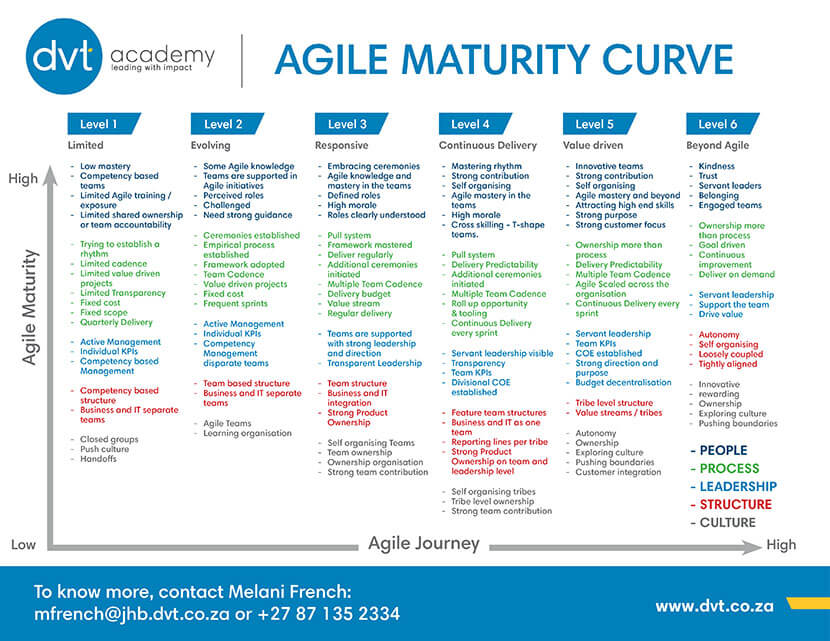
Agile is not just an IT framework. It’s more than just a ‘new way’ of doing projects. In fact, when I speak of Agile, I’m referring to five fundamental and very different aspects of the concept as a whole: people, process, leadership, structure and culture. Before I can answer the question – how far can you go with Agile – let’s first consider these five pillars of Agile in more detail.
People
This is probably the easiest aspect to grasp and simply speaks to how we treat one another and how we view our people and staff as an Agile business. Agile is totally people focused, empowering and liberating, so this pillar is key to the success of an Agile way of working. Agile enables people to be fully engaged, at their best performance and responsive.
Process
Agile is not linear. There are different frameworks and methodologies to choose from, all of which form part of the process we ultimately decide to follow. These frameworks are there as a guide to help us reach our goals as an Agile organisation. The purpose of the various frameworks is to get us into a habit of doing things differently and to be more relevant to the market and responsive to change.
Leadership
Agile defines leadership as the positive, empowering and supporting influence you have on people, and the feedback you receive in return. This only occurs within the context of a relationship. In contrast, active management is focused more on what you can get from your people because you pay them.
Structure
Agile calls for an organisational structure change where people are loosely coupled but tightly aligned, thus able to make lower level decisions while staying consistent in what we are trying to achieve as a team. As long as the vision is shared, it’s up to the team to find a solution and drive the delivery.
Culture
Probably the most important but least understood of all the pillars, culture speaks to factors such as autonomy, ownership, freedom and innovation. A strong, agile culture exists when direction doesn’t need to be given on a daily basis, only guidance since the vision and goals are shared with the team in context. Agile breeds a no-fear culture, where the business through its people isn’t afraid to fail to succeed.
Now that we have a handle on the five pillars that make Agile what it is let’s look at the three components that support every Agile transformation: mastery, purpose and autonomy.
1. Mastery.
You want to enable your staff to master this thing called Agile, what it is, and what it’s not; what it means to your organisation, the governance you need to put in place to steer the course, and ultimately how to navigate your new Agile business. Things like Agile Training, consulting sessions, directions and transparency during the journey are key.
2. Purpose.
There’s a purpose behind every Agile transformation, programme and project - not only at an organisational level but also on a personal and interpersonal one. There’s an overarching purpose – to make the business more successful, or to break into new markets, for example, and also a softer purpose – to make a difference in people’s lives or to make it easier to achieve their career goals. Whatever your purpose, it’s important that people buy into it and that it is common knowledge. I’ve often heard of people who gave of their time or joined organisations for free because they bought into its purpose and what it was trying to achieve, simply to be part of it.
3. Autonomy.
This is self-explanatory – and also self-perpetuating. If you’ve mastered Agile and have a well-defined purpose, you become autonomous based on trust. As a leader, I share the value of appointing people you trust, and trust them to get the job done.
Now that we understand how an Agile transformation works in relation to the five pillars of Agile, we can start to think in terms of Agile maturity. Companies undergoing an Agile transformation are typically graded by where they are on the Agile Maturity Curve. There are six grades along the curve: limited, evolving, responsive, continuous delivery, value-driven and beyond Agile.
All but a small number of companies starting their Agile transformation journey or setting off from a large and cumbersome legacy base find themselves at a level one (limited) grade. Even fewer will ever go beyond Agile, which today is epitomised by the likes of Google, Facebook, Apple, Spotify and other industry pioneers that have redefined what it means to be Agile. Most companies fall somewhere in-between.
Like most things in Agile, there’s no hard and fast rule on what makes one company ‘responsive’ and another ‘value-driven’. There’s an old saying that says ‘you don’t know what you don’t know’. Most Agile ‘sponsors’ are also high-level managers that have been with the organisation for a long time and don’t have a context on what should be done differently to how it’s always been done. Often the company’s people and processes are very mature, but the leadership – in Agile terms – is not. Alternatively, everything else is in place, but the organisational culture is keeping the business anchored.
This is where astute mentorship is key, because Agile maturity isn’t just about expensive training and leadership courses, but rather focused on coaching in the areas that need strengthening or alignment. Looking at the Agile Maturity Curve will give you a better idea of what the end goal looks like and focusing your budget appropriately. Sometimes it is more spent on change management and influencing the culture, as appose to Agile training and coaching.
Surprisingly, most of the change will come with the ‘softer’ aspects of Agile – how you treat people, enable people, lead people. An Agile way of working in an Agile organisation often lies in finding the right level of collaboration and communication. Sending your staff on an Agile framework course won’t teach them how to be Agile. Soft training and Strengths-based training will assist in this area.
Take a longer look at the organisations that have truly gone beyond Agile, and they’ll all put their success down to the ‘softer’ aspects of kindness and trust, a sense of belonging and ownership instead of a process or management focus. It’s very different to the conventional way of thinking, and how we traditionally get people to move in a certain direction, but there’s also no question that it works.
So how far can you take your business with an Agile transformation? Tread softly, and before you know it, you will have a friendly, learning organisation which is engaged in the organisational purpose - operating as high performing teams.
About Melani French
Executive head of DVT business enablement
 Melani heads up DVT's business enablement and Agile transformation practice. She is responsible for the delivery of consulting and training services to clients in the Agile, program management, project management and business analysis space. Having joined DVT as an Agile leader in 2011, Melani's strong technical, delivery and leadership background enables her to assist many organisations to optimally deliver solutions. Her passion is leadership and Agile delivery since these are essential for companies to thrive in a competitive market.
This article was published exclusively on ITWeb on 3 July 2018.




Designated as the ‘automation specialist of choice’ by Old Mutual S.A., veteran software testing group DVT is setting its sights on the UK, eager to help new clients in a post‑Brexit world.
Now that 2017 is fully underway, Editor of TEST Magazine Cecilia Rehn caught up with Chris Wilkins, CEO, DTH and Bruce Zaayman, Director: DVT United Kingdom, to discuss how this South African powerhouse is poised to help UK businesses optimise automation this year.

CEO of Dynamic Technology Holdings

Director: DVT United Kingdom
DVT is well known as one of the largest, privately‑owned software testing groups in the southern hemisphere, but can you give us an introduction for our European audience?
Chris Wilkins: DVT started in Cape Town in 1999 and we have built up our group to a staff of 600 professional software developers, testers, business analysts, project managers, architects.
At heart we are a software development company and over the last 10 years we’ve recognised that software testing is becoming more and more important, so we built up a very large and very competent testing team. This is made up of 200 - 250 testing professionals, which includes our Global Test Centre facility in Cape Town, one of the largest, specialised testing facilities in the southern hemisphere.
Our clientele spans from large finance and insurance firms and media companies, down to smaller organisations such as Doddle.
Our focus in testing is automation; we believe that the world will slowly move towards automation, and we believe that outsourcing software testing and commoditising it, and making life easier and allowing enterprises to focus on the more specialised, and possibly more interesting, QA jobs is the way to go.
What are the main services that DVT provide?
Bruce Zaayman: We provide agile software development, testing, consulting and training.
We have also built our own test automation framework, which means our clients don't have to pay any license fees for their testing projects. The main reason we developed the java‑flavour, UTA‑H (Unified Test Automation – Hybrid) framework is because a lot of companies don’t want to spend the money on the big players. You know, the HP titles or the CA type tools. For that reason, this is based on Selenium web driver, saving costs as we’re not limited by a license for one individual machine.
If we need to run through a massive amount of work in a short amount of time we spin up a couple of VMs and we can run on double, triple, the amount of machines in order to reduce the time. So that’s a major selling point and I think that that’s something our clients look for.
CW: Everybody wants flexibility; everybody wants scalability. We, as a company, are pragmatic delivery specialists; we’re not trying to play in that big generic space. We’re not looking for these massive deals; we’re just saying ‘we can get the job done for you.’ The framework’s been built with that in mind, to get the job done, and it’s 80/20. Once the process is more or less 80% complete, the learning curve has been so dramatic that it makes that last, more challenging 20%, that much quicker and easier.
BZ: We also use other tools for automation frameworks. We are agnostic, if a client has a tool, then we are more than happy to augment that team with our service offerings and our skills. To us, an automation specialist is not just a functional software tester with some tech background; we have a java‑development type of resource that is useful. We run test automation from a development point of view, and find that this flexible and scalable approach works very well.
What can a South African venture offer to the UK/European market?
CW: Post‑Brexit, we think Britain is looking at being more of a global citizen again, and we believe South Africa is a culturally and economically sound partner.
In terms of IT outsourcing, we believe the Indian model, although effective for some companies, is not specialised, nor boutique enough for most. And when you consider the euro’s recent increase, other Eastern European options have become more costly. In contrast, the South African rand is extremely competitive, which means that there is a strong case to say that partnering with a Cape Town‑based firm can be a cost reduction and cost mitigation, strategic exercise as well.
However, we consider our strengths to be based on more than economics. When it comes to cultural familiarity, there’s a strong link between Britain and South Africa. We’re part of the same Commonwealth, share a common language, and the same time zone so you can pick up the phone and talk to someone straight away. A lot of Brits travel to and from South Africa, and a lot of them have families there as well. So there’s a strong sense of it being part of the British framework.
And of course there are loads of South Africans working in London and in the UK. These cultural links are so important for IT outsourcing in particular, when miscommunication could have huge ramifications for a project. South Africans' first language is English, they are educated in a system that reflects the British educational system and our best practice, the way we do things, the way we work, the methodologies, the jargon, they are all exactly the same.
On the whole I think communication is as easy as it can get. We are a much easier country to work with than any of the other primary sources of offshore work at the moment in Eastern Europe and India.
A key part of DVT’s business is your Global Testing Centre. How does this support your offerings and clients?
CW: The Global Testing Centre is a natural extension of our testing service. It’s all about having your testing carried out remotely, so you don’t have to hold onto the headache of staff, you don’t have to manage your peaks and troughs as large projects come and go in quick succession. Our clients don’t have to worry about finding very specialised skills for 10 hours a month; we’ll find them internally.
So the logistical benefits are enormous, it just takes away the nuisance.
We will also make sure that the bridge between the clients and the test centre is built and that it is maintained, and that there is just the right flow of communication that goes on between them. Every client is on a different maturity curve when it comes to software testing, and we provide a tailored, bespoke service.
Because DVT’s focus and expertise has been on automation, we can consult and advise on how to tackle the more emotional aspects of automation with your staff, how to take them down that road, how to get them onto that first rung of the ladder, and then how to continually invest so that over time your automation gets faster and faster.
We ensure clients can get product to market faster, and most importantly that no one is holding up all of the expensive software developers who keep waiting for testing to finish.
Our global test centre can facilitate all of that.
BZ: The GTC is structured into pods of 30‑50 odd people, run by senior technical managers. This structure ensures that there’s always senior technical knowledge onsite, in close contact. All resources allocated to clients have senior oversight. South Africans, in general, are very positive to working with international clients and forging global business links. So we ensure we have talented staff onsite with the technical knowhow to support clients, and the enthusiasm to go above and beyond.
CW: Enterprise firms like the GTC because we have the size and the scale of a larger organisation structure and start‑ups like us because we have agility in that centre and we can move around quickly. Also, the really good news is that we always have 10 to 15 people available at short notice. We would encourage any new client to work with us on an initial proof of concept, which we can often turn around in a couple of days or weeks. This would be an investment by DVT into a client, to demonstrate the way we work, the kind of experience they might get if they signed us up as a more strategic partner.
You’ve recently partnered with British TSG, what does this partnership look like?
CW: We were initially introduced through mutual acquaintances 18 months ago. This partnership makes sense: TSG went through an MBO last year, so with new ownership and invigorated management, they are tackling the market with fresh eyes. They’re British owned, British managed with blue chip clients.
As specialists in the UK market and with high‑end consultative skills, TSG really complements our proposition as an outsourcing destination. Partnering with TSG allows us close proximity with the client and senior boots on the ground, whilst we give TSG scale, flexibility, and dynamism, all in the same language and same time zone.
Working closely together from TSG’s City offices, we serve as the preferred offshore partner. I think every British software vendor or testing specialist needs this flexibility for their clients. To stay competitive, it’s an absolute necessity.
TSG is our partner of choice. We don’t want to have to have a shotgun approach to partnerships. We’d rather have just one very good partner, and of course, we want to accelerate this business together now and win new UK clients.
What are your thoughts on trends in outsourcing for 2017 and beyond?
CW: It is clear that organisations will need to invest in various different avenues to tackle testing challenges, including cost‑effective outsourced partners and a serious focus on automation.
What it boils down to is that we need less and less actual people to do more and more testing work. With the legacy that surrounds an enterprise today, there’s an enormous amount of software, lines of code. I think automation is critical otherwise costs, time and effort will balloon out of proportion. You will not be able to keep up with more agile competition.
We’re offering a specialised solution; we’re not trying to do mass‑produced stuff. South African outsourced staff have opinions, they’re not just going to sit and do as they’re told and say ‘yes’. They will question and talk. So I think we could be a very refreshing option for people wanting to outsource.
We’re a good company to work with if you want to slowly, first of all, outsource and have a manual oriented approach, and then transition across into a more automated environment. So, we tick the boxes on both sides, and over the 10 years of developing our QA competency, obviously being software development specialists we’ve introduced all the learnings, and techniques, and best practice. But not best practice in just a global generic sense, but best practices in the way that we feel what is the right way to test software.
Another key concern for organisations is how to cope when you need some specialised skill or opinion or consulting for a just a few hours a week or a month? If you’re not outsourcing, you’ve got to go find that skill somewhere if you don’t have it in‑house. We’ve got a big test team, an extended team through the company as well, so we’re more than likely to find it internally. Increasingly, organisations are finding out that this can be a big advantage. Immediate access to specialised knowledge and insight can clear log jams very quickly.
You’ve been in the industry for a long time, how do you think testing and QA is changing?
CW: I don’t think it’s changing fast enough. I think the extraordinary high amount of software code out there means that actually regression testing is, or should be, one of the primary focuses for enterprise, not just for quality, but also for speeding up the entire delivery lifecycle.
Automation testing products are reaching a better level of maturity. We’re seeing for the first time in the last few years that these products really can do the job, which means that testing automation will start coming into its own in the next five years.
So we believe in automation and offshoring, but with a more boutique flavour; not mass production ‘throw 20 more people at the project’ ideology that’s been adopted by other jurisdictions. This is a tired tactic, and we need a sharper, more adaptable approach now. And of course Brexit is going to introduce its own peak of regression testing where small code changes are going to have to be made to accommodate compliance for whatever Brexit regulations are agreed upon.
So, where is it going? There’s more formality around it, I think everyone agrees that getting an expensive java developer to test is crazy. You actually need to make sure you have a separate team with a separate responsibility with people who are trained to test not to code. There’s going to be some type of tension in post‑collaboration between those two teams. Software developers also write their own codes, so they’re more inclined to test it and say it’s okay quite quickly.
And it’s not only the code; it’s the UX as well, which is also becoming more important as the end users’ expectations change.
We’re looking forward to showing the UK what we’ve got, and helping this market navigate post‑Brexit uncertainty with a strong, neighbourly partner!
For more information about DVT please visit: www.dvt.co.za
Source: This article was published in the March 2017 edition of TEST Magazine.

By Willem Botha, DVT
With the ever increasing need for software development teams to react faster and deliver quicker solutions to problems, agile has become an essential framework to follow. That said, what is the role of the Business Analyst (BA) in an agile world and is the BA still needed as part of the team?
Let’s start at the beginning and go back to the basic definition of business analysis. According to the International Institute of Business Analysis (IIBA), a BA is a liaison among stakeholders to understand the structure, policies, and operations of an organisation, and to recommend solutions that enable the achievement of goals.
Thus the BA’s role is not centred on software; it is about suggesting solutions to business problems and enhancing processes. Software can be part of a BA’s recommendations which a stakeholder would then vet and forward on to a product owner for detailed evaluation as a product enhancement.
In agile when we are talking about a BA or agile BA, we are typically referring to the technical BA when software was part of the recommendation already.
Does the agile BA exist?
Let’s have a look at the characteristics of an agile BA according to the agile manifesto:
- Adaptability: Everyone associated with agile must be adaptable. However, the traditional BA has always needed to adapt to the business process, software development process or even a lack of process.
- Goal Oriented: The goal is to add value to the organisation by solving business problems. This is true for both the agile BA as well as the traditional BA role.
- Innovation: The agile BA, as well as the traditional BA, is looking for new approaches to solving the business problem and improvements to the business processes in which the problem exists.
- Leadership: Being an agile BA or traditional BA means taking the lead in providing solutions to business problems.
- Empathy: The BA deals with the business sponsor, customers, users, solution team, technical personnel and management. Both the agile BA and traditional BA need to exhibit empathy and understanding for all these roles.
- Business Oriented: While the agile software development team is focused on the technological issues of producing working software every two weeks, the agile BA needs to provide the business justification. This has always been true for the traditional BA.
- Anticipation: The agile BA, as well as the traditional BA, must be thoroughly familiar with the problem domain, the business area in which the problem exists and to anticipate positive and negative impacts to other areas of the organisation.
Based on the characteristics listed for an agile BA we can see that there is clearly no difference to the traditional role played by the BA. So if the agile BA does not exist, do we need the business analysis role in agile?
The answer is a definite yes! But, why am I saying this?
Let’s look at what the most successful agile teams have in common:
- Everyone in the team understands the “Why”.
- In the agile world, the BA needs to manage the communication channels with business to understand “why we are working on something.”
- The BA needs to foster a shared understanding, thus a two-way communication flow between development and business.
- Teams can make faster decisions by getting answers quickly.
- With distributed teams where product owners sometimes oversee multiple projects, the agile BA understands the product vision to provide the answers to questions from the teams.
- On smaller teams, the product owner and agile BA role are played by the same person. However, the focus is still on clear communication to all team members.
- Although the BA role might not exist in the agile team, the skills associated with a BA is still needed.
- In smaller teams the product owner may have the required BA skills, making the BA role redundant. That said, the product owner role is usually played by the BA.
- In bigger teams, the agile BA provides the detailed requirements for the different product owners.
- The development team still needs someone to take the lead in analysing business requirements and facilitating the process with business.
- Keeping the noise away from the team and providing clear prioritised work for two-week sprints.
- There’s still a need to facilitate requirement sessions and documenting these requirements clearly.
- Where detailed requirements are necessary, documentation needs to be based on a set template for the team following Unified Modeling Language (UML) standards.
- The team decides when detailed requirements are necessary. However, documenting the business requirement is still required for new members joining a team.
Now if we are saying that the role of the BA might not be needed in an agile team - but only the skills associated with the role, are developers able to play this part in the team? I asked the development community I work with to provide me with answers to this, and it was clear that it depends on team dynamic and the size of the project.
Team dynamic
- If the team has dedicated developers, then they cannot play this role. They have to wrap their minds around difficult technical concepts. They will not be thinking in abstract or general terms and will be busy with the specifics.
- A representative for the business requirement is still needed. Someone must have a clear singular focus on the business need and guarantee that this prerequisite is solved and achieved.
- Sometimes if not done correctly, developers will solve problems that do not exist or invent their interpretation of the business requirement.
- If you have a team of agile people working toward a common goal, where each person does what is best for the project and team at any given time, then yes, the same person who writes code can also perform the function of business analysis.
Nature of the project
- With bigger projects, the role of the BA is better suited for requirement analysis and documenting these requirements in advance, with the development team left to focus on the work in the current iteration.
- Conversely, there are smaller projects where the development team could easily just sit with the business owner and understand the full scope of what is needed.
Business analysis should not be focused on software thus falling outside of the agile process. The notion of an agile BA is not new; it is still the traditional role played by the BA. Moreover, once software has been identified as a solution the BA or technical BA role is still needed in the agile team.
The core principles of the BA role still exist and are needed by the team. Agile has merely freed up the BA to be a BA, instead of a technical BA. These core principles are:
- Facilitate communication and understanding.
- Set team objectives per iteration.
- Fill the role of the business owner or Product Owner proxy
The need for quality analysis in a world of increasing change and technological complexity is high. The role of the technical BA does not have to be a particular person. However, the responsibilities of the role should not hamper delivery from a development point of view.
Agile has also changed the way the BA plays his or her role. The amount of analysis has changed - BAs only do what’s necessary, ensuring that there is no waste in the analysis process.
Focus on T-shaped skills
According to HRZone.com, T-shaped skills describe specific attributes of desirable workers. The vertical bar of the T refers to expert knowledge and experience in a particular area, while the top of the T refers to an ability to collaborate with experts in other disciplines and a willingness to use the knowledge gained from this collaboration.
What does this mean for the business analyst? It means being more aware of the customer journey; what problem needs to be solved, why business needs the product and ultimately how customers will use the product.
Finally, influence the team dynamics by working closely with the product owner, development team and business to help establish a shared goal.
At the end of the day, it is the goal and not the role that is important. It is also clear that the business analyst has an essential role to play in an agile world.

I tend to simplify. Perhaps over-simplify. Ask my 14-year-old daughter how often she hears “That’s really quite simple” to which she has to answer, “No, it’s not.” She’s probably right, however, given I’m older than her, I have a decent shot at being right. At least once. Perhaps it’s this time when considering just how simple all this new tech capability is in the digital business world. Really! Hear me out. (Stop rolling your eyes.)
Selling the Drama
I love the band LIVE. Their track “Selling the Drama” includes the verse,
I've willed, I've walked, I've read
I've talked, I know, I know,
I've been here before, yeah
Incredibly relevant to simplifying things (and my posts). Mantra: It’s been done before despite all the new talk.
Hype seems to surround tech advances these days more than ever. I think the Gartner Hype Cycle should reflect a MUCH steeper and MUCH higher front end to the peak of inflated expectations. The Hype Cycle is a great litmus test for the “fake news” of how AI / blockchain / (substitute new tech here) is going to solve all problems, take all jobs, get absolutely anyone elected to President. The BOTs have arrived, People. Ask them to take you to their leader. Who is that? Amazon? Google? Facebook? Apple? All plausible candidates. Perhaps look for whoever is SCL’s (Cambridge Analytica’s parent) next big client. Not sure what that last reference is about? Conversation for another day / post.

Back to topic. Simplicity in the face of tech hype. Gartner was already mapping the transformation of business in 2014 due to the “Nexus of Forces” (SMCI – social, mobile, cloud and information). 2014, that’s so long ago right? Have those elements been replaced now by BOTs, AR (augmented reality), ICO’s and Thinking Machines? Yes, the acronym would be BAIT. Wonder why? Simplified view (an opinion with which you are free to disagree – please do) is that no, the big trends of SMIC are still the major trends. They have spawned new focus elements (BAIT are examples) and will continue to do so at speed. Probably almost as fast as the changing value of Bitcoin. Is it really that difficult to stay up to speed and leverage the new opportunities in these and other trending technologies? Again, no. Not when you can over-simply as I do. Hence the easy as Ai, Bi, Ci.
Easy as AI, BI, CI
Any reading (meaning YouTube search) on AI will point you to the fact that AI has been around for a long time. Like more than a year! (That’s my Daughter’s comment.) The flood of exposure in the media and online platforms is just a reflection that the tech has found its way into (early) easy to try / use formats. Google, Microsoft and Amazon all have incredibly capable variants that are made available for use through UI driven configurations. Yes, UI driven. Fill in the boxes, point to data, submit. Watch machine do smart things. The end is nigh. Except not. ML has been around for a long time. The algorithms were just tough to create, needed huge processing power and required stuff the rest of us mortals avoided: math and stats. Yuck. But now that’s hidden behind a nice shiny wrapper of cloud computing and add-ons (billable). So, we now all have access to do smart analysis and use correlation. However, what to do with that new hammer? Are you looking for a nail or do you have one? Other aspects of AI similarly are becoming incorporated easily into process/applications. As examples NLP (natural language processing) is ubiquitous (just ask your smartphone) and available as a service for incorporation into your business processes (think online support chat by BOT). More? Computer vision and robotics in warehouses (ask Amazon), Ad targeting in Facebook and Google, AR apps on the App Store. All too simple?
Business Intelligence (BI) similarly has been a part of the corporate landscape forever. At least as long as Internet Dinosaurs like myself remember (I am a fossil in current Internet age terms). The accelerator these days is that the tech has moved the capability from the IT department (“give me a report please IT”) into the hands of the business users (“I’ll do it myself thanks with Excel / Power BI etc.”). Fantastic. Faster, better, mobile, more. Bad decisions made with confidence based on bad data. Damn. Thought that does point out the new role for IT in partnership with Business: effective Data Stewardship and Data Strategy. Modern BI capability is available via instant online subscription and comes with immediately available AI links by the way. Imagine that. Challenge is, as before, do you know the right questions to be asking of this new analytical wonder? Do you have the data you need? Is that data complete, accurate and secure?
CI (Continuous improvement) is my last pick in justifying my “it’s all easy in digital” throwaway statement. With links to six sigma and subsequent variations, the change in accessibility and capability nowadays is absolutely stunning. You can learn about CI in bite sizes of your choice on YouTube. Enough to understand what it is and… plug into a platform that will do the work for you and present the analysis in pretty pictures. Dinosaur-day processing constraints that necessitated sampling data (n=20 right?) are gone. We have scalable cloud processing and storage. Just process ALL the data. Now. No sample. Technique of analysis: leave it to the machine to find the best statistical fit. What was your hypothesis again? That’s probably still the most important question. Also, the human element that requires some creativity and intuition to get to an analysis that will deliver value faster. If you always do what you have always done, expect similar results (until someone eats your lunch). If you leverage CI, you seek improvement, innovation, revolution and becoming the moving target. Just move fast. Remember Bitcoin.
Value (forget the rest, read this)
Hype is greater than ever surrounding new tech and its progression. The speed and seemingly SCI-FI type new capabilities (Googles AlphaGo) astound on a daily basis. Despite the new acronyms (we in IT and Consulting make a living out of those), the new things really are just old things made easier. That’s good news. AI, BI and CI are phenomenal levers to apply in your world (business or otherwise). Their ability to help drive innovation, improvement and revolution are limited only by their maturity (check the Hype Cycles please) and the creativity of us simple users. Start your process with the simple question “What value can I deliver and where is the opportunity to find that value?” (Don’t tell the machines this. It’s our secret advantage given we can actually answer that question.)
We all got a lot smarter, faster and capable thanks to first knowing our ABC’s and now our Ai’s, Bi’s and Ci’s. Need a plan of attack for what to do next? See my next post or check YouTube. It’s probably there already in a perfect 2’35” clip by some BOT that just parsed this post. But then you already knew that given you had SIRI find and read this article to you, right?